Albany County Land Bank takes a new approach
Read the whole article here. Excerpt below.
Since its creation in 2015 as a nonprofit community development organization, the land bank has mostly served as a bridge for the county government’s tax-foreclosure process.
The county has conveyed title to hundreds of abandoned homes and empty lots to the land bank, which then offered the properties for sale to investors and those wanting to repair and live in the houses.
Most parcels were in the city of Albany but others were spread throughout the county.
Some homes sold pre-pandemic for as little as $5,000. Others went for considerably more. There were also properties, such as empty lots, that never found a buyer.
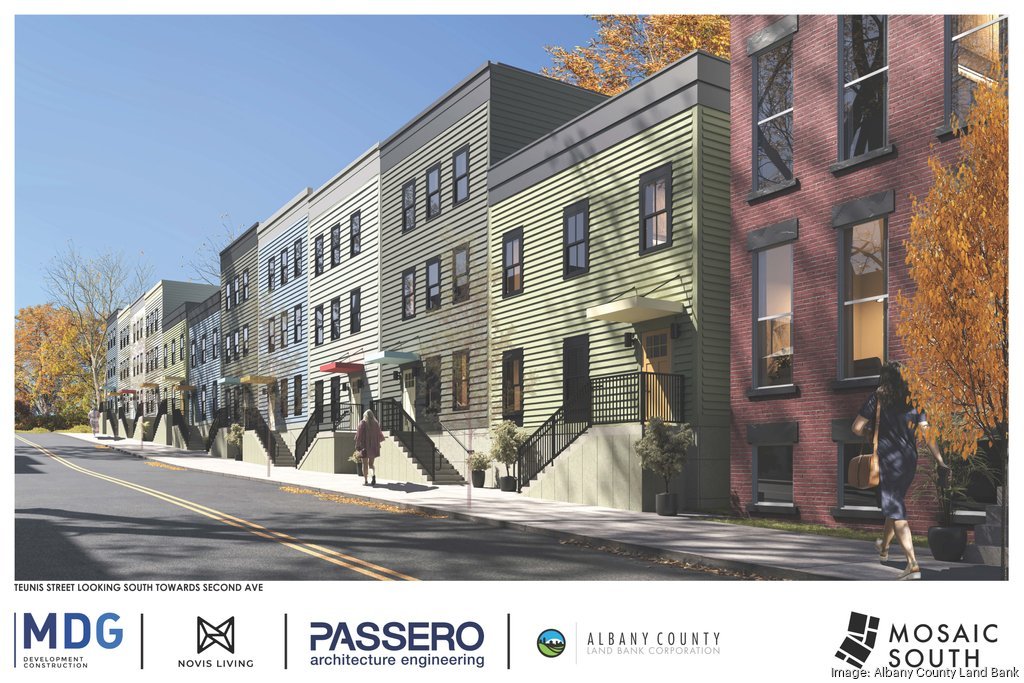
A rendering of the planned Mosaic South development on Teunis Street.
Six years ago, the land bank started taking a different tack by seeking private development partners for a large cluster of vacant parcels in the South End (two smaller clusters are elsewhere in the city). That’s how Mosaic South came about.
Meanwhile, three homes were renovated by the land bank and sold, including two on Second Avenue in the South End — similar to the one that was recently completed around the corner on Elizabeth Street.
Now, due to various factors, the land bank has pivoted to doing more of its own renovations rather than relying on the sale of properties conveyed to it by Albany County.
A major reason is the foreclosure process slowed to a trickle in New York due to a two-year moratorium that was enacted by the state Legislature after the Covid-19 pandemic hit in 2020.
Then, in May 2023, the U.S. Supreme Court ruled the tax foreclosure process in Hennepin County, Minnesota, was unconstitutional.
The case involved a 94-year-old woman who had stopped paying taxes on her condominium after moving to an assisted living facility. Hennepin County foreclosed, sold the condo at auction for $40,000, and kept the $25,000 in excess of what was owed in taxes and fees.
The Supreme Court ruled the county’s retention of the $25,000 violated the “takings clause” of the U.S. Constitution.
Local governments in New York, including Albany County, had conducted tax foreclosure sales similar to the manner in Hennepin County, according to Historic Albany Foundation.
The advocacy group viewed the Supreme Court decision as potentially hurting the land bank because it was using excess sale proceeds from county auctions to help pay for renovations to deteriorating homes.
In response to the high court’s ruling, the New York Legislature in April 2024 changed state law to require “surplus proceeds” be distributed from the sale of tax-foreclosed properties to the former owner or lien holder, according to the state Department of Taxation and Finance.
Last April, Albany County adopted a new property disposition plan that it says conforms with the revised state law. The policy prioritizes holding an auction for parcels that have potential equity exceeding the amount of taxes owed, according to the county Department of Management and Budget.
A push to stabilize properties
While the land bank can continue to get title to tax-foreclosed properties, the pipeline has slowed to a trickle over the past several years as auctions were delayed.
The days of acquiring a large volume of foreclosed properties every year from the county, and getting the excess proceeds from auctions, are over, Maguire said.
“We’ve had to rethink [how] we’re going to be sustainable,” he said.
“We’re going to be sustainable by stabilizing properties like this, getting them back into the neighborhood, getting a family back in here,” he added.
Turning an abandoned row house that has suffered from years of damage and neglect into a safe, functional and desirable place to live — at a price affordable to a first-time home buyer — is a major challenge.
There was a $400,000 difference between the list price of 79 Elizabeth St. and the total cost of the renovations that were done by WPNT Construction LLC of Selkirk.
The land bank was able to fill the gap with the help of state grants.
There are nine more homes, not all in the Sound End, that are being analyzed to decide which ones are the best fit for the next renovation.
“We’re trying to not lose money at the end of the day,” Maguire said. “Instead, we’re trying to be smarter about where we tap into the resources to advance the land bank."