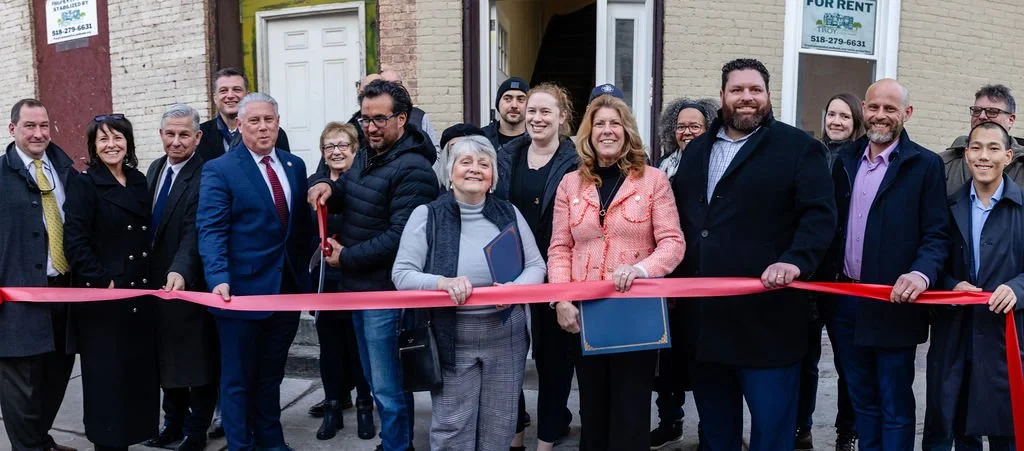
Kingston City Land Bank Helps Two Families Own Their Own Homes

The KCLB was founded in 2018 with support from the city as part of an effort by Mayor Steve Noble to move more Kingston families from rental housing to their own homes. Noble has said that affordable home ownership programs like the KCLB help stabilize neighborhoods while giving moderate-income families an opportunity to generate wealth. On Friday, Noble praised the land bank’s efforts on the two lots which are around the corner from each other as well as a pending effort to build affordable multi-unit cooperative housing on a vacant lot adjacent to 52 Grand St…

The KCLB has renovated and returned to the tax rolls and sold 15 vacant homes held by the city for back taxes and acquired under a disposition policy that requires the nonprofit to pay off all back taxes on a property. After an initial effort funded by the NoVo in Kingston foundation renovated nine properties, the KCLB began work on acquiring and rehabbing another six as part of the “keystone” program funded through the city’s American Rescue Plan Act award and the state Division of Homes and Community Renewal.

Friday’s ribbon-cutting marked the completion of the keystone program and the final disposition of the last six properties in the KCLB inventory. But a 2023 Supreme Court ruling could complicate further efforts. The ruling, Tyler vs. Hennepin County, ruled that municipalities like Kingston may take properties for nonpayment of taxes, but if the property is subsequently sold, any profits in excess of the back taxes must be returned to the original owner.

Read the full story here.

Albany County Land Bank takes a new approach

Read the whole article here. Excerpt below.

Since its creation in 2015 as a nonprofit community development organization, the land bank has mostly served as a bridge for the county government’s tax-foreclosure process.

The county has conveyed title to hundreds of abandoned homes and empty lots to the land bank, which then offered the properties for sale to investors and those wanting to repair and live in the houses.

Most parcels were in the city of Albany but others were spread throughout the county.

Some homes sold pre-pandemic for as little as $5,000. Others went for considerably more. There were also properties, such as empty lots, that never found a buyer.

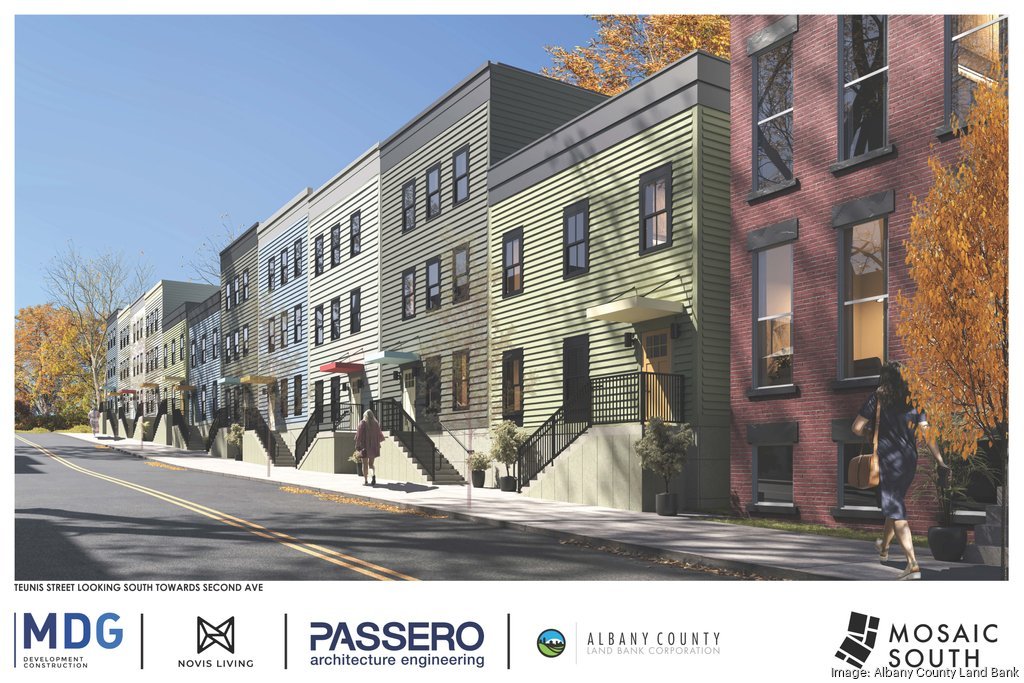
A rendering of the planned Mosaic South development on Teunis Street.

Six years ago, the land bank started taking a different tack by seeking private development partners for a large cluster of vacant parcels in the South End (two smaller clusters are elsewhere in the city). That’s how Mosaic South came about.

Meanwhile, three homes were renovated by the land bank and sold, including two on Second Avenue in the South End — similar to the one that was recently completed around the corner on Elizabeth Street.

Now, due to various factors, the land bank has pivoted to doing more of its own renovations rather than relying on the sale of properties conveyed to it by Albany County.

A major reason is the foreclosure process slowed to a trickle in New York due to a two-year moratorium that was enacted by the state Legislature after the Covid-19 pandemic hit in 2020.

Then, in May 2023, the U.S. Supreme Court ruled the tax foreclosure process in Hennepin County, Minnesota, was unconstitutional.

The case involved a 94-year-old woman who had stopped paying taxes on her condominium after moving to an assisted living facility. Hennepin County foreclosed, sold the condo at auction for $40,000, and kept the $25,000 in excess of what was owed in taxes and fees.

The Supreme Court ruled the county’s retention of the $25,000 violated the “takings clause” of the U.S. Constitution.

Local governments in New York, including Albany County, had conducted tax foreclosure sales similar to the manner in Hennepin County, according to Historic Albany Foundation.

The advocacy group viewed the Supreme Court decision as potentially hurting the land bank because it was using excess sale proceeds from county auctions to help pay for renovations to deteriorating homes.

In response to the high court’s ruling, the New York Legislature in April 2024 changed state law to require “surplus proceeds” be distributed from the sale of tax-foreclosed properties to the former owner or lien holder, according to the state Department of Taxation and Finance.

Last April, Albany County adopted a new property disposition plan that it says conforms with the revised state law. The policy prioritizes holding an auction for parcels that have potential equity exceeding the amount of taxes owed, according to the county Department of Management and Budget.

A push to stabilize properties

While the land bank can continue to get title to tax-foreclosed properties, the pipeline has slowed to a trickle over the past several years as auctions were delayed.

The days of acquiring a large volume of foreclosed properties every year from the county, and getting the excess proceeds from auctions, are over, Maguire said.

“We’ve had to rethink [how] we’re going to be sustainable,” he said.

“We’re going to be sustainable by stabilizing properties like this, getting them back into the neighborhood, getting a family back in here,” he added.

Turning an abandoned row house that has suffered from years of damage and neglect into a safe, functional and desirable place to live — at a price affordable to a first-time home buyer — is a major challenge.

There was a $400,000 difference between the list price of 79 Elizabeth St. and the total cost of the renovations that were done by WPNT Construction LLC of Selkirk.

The land bank was able to fill the gap with the help of state grants.

There are nine more homes, not all in the Sound End, that are being analyzed to decide which ones are the best fit for the next renovation.

“We’re trying to not lose money at the end of the day,” Maguire said. “Instead, we’re trying to be smarter about where we tap into the resources to advance the land bank."

The emergence of the Essex County land bank as a force in affordable housing

Feb 24, 2026 — The Essex County Land Bank was established just three years ago in hopes of alleviating a growing housing crisis in the eastern Adirondacks. We take a look at what a land bank is, and how any community can rack up some wins for affordable housing by starting its own.

Listen here to this piece by North County Public Radio (starts about 3 minutes into the recorded audio).

Troy Community Land Bank Takes on Three Vacant Properties

TROY, N.Y. — At its most recent board meeting, the Troy Community Land Bank (TCLB) Board of Directors voted to invest $1.1 million into the rehabilitation of three long-vacant properties in the City of Troy, signaling another major step forward in the Land Bank’s mission to return blighted structures to productive use.

According to a press release, the approved properties — 834 River St., 871 River St., and 3340 6th Ave. — will be transformed into quality residential and mixed-use housing options, creating a total of eight new units, including one commercial storefront. The average construction cost across the three projects is $138 per square foot, or $136,000 per unit — a reflection of the Land Bank’s commitment to efficient, high-quality redevelopment.

BENLIC Breaks Ground on Infill Homes

Mayor Christopher P. Scanlon today, alongside Erie County Executive Mark C. Poloncarz, the Buffalo Erie Niagara Land Improvement Corporation (BENLIC), and other local leaders, broke ground on a transformative housing initiative that will bring 47 new affordable single-family homes to long-vacant lots across the city. All properties will be reserved for income-qualified buyers, with a purchase subsidy to assist families achieve new home-ownership opportunities. 

The groundbreaking marks the start of construction on the first 47 homes, with properties being developed in the Riverside, Black Rock, Ken-Bailey, University Heights, Lower West Side, and Old First Ward neighborhoods. The $24.5 million investment, funded jointly through American Rescue Plan dollars from the City and County, represents the largest infill housing program Buffalo has seen in decades.

BENLIC Executive Director Jocelyn Gordon said, “This development of 47 homes is just the beginning: we’re excited to build on this momentum, sustain this program for the long term, and continue implementing solutions that create stable neighborhoods for City of Buffalo residents.”

Read the full story: https://www.buffalorising.com/2025/04/benlic-breaks-ground-on-infill-homes/

Dozens of new homes planned for vacant lots in poor Syracuse neighborhoods

In Syracuse, the Block-by-Block program has prompted a flurry of vacant land purchase offers in the past three months to the Greater Syracuse Land Bank. Nonprofit organizations focused on providing affordable housing are turning to the agency, which acquires, stabilizes and sells properties seized through city property foreclosures.

Since January, the land bank’s board has approved sales of more than 25 empty lots clustered on blocks in South Side neighborhoods and the Near West Side to nonprofits eyeing the new state program to fund single-family home construction.

The land bank has also entered into an agreement with Jubilee Homes, a South Side-based nonprofit economic development organization, to develop 10 two-family houses on parcels it owns on the Near West Side and fund the work with Block-by-Block grants.

Both areas of the city have been hit hard by the severe shortage of quality housing that’s also affordable to Syracuse residents. Mayor Ben Walsh’s administration launched a program in 2020 to get 200 units of new housing built on vacant lots in distressed areas of the city, and with a combination of local, state and federal funds, those goals have been reached five years later.

Read the full story: https://www.syracuse.com/news/2025/03/dozens-of-new-homes-planned-for-vacant-lots-in-poor-syracuse-neighborhoods.html

The Greater Syracuse Land Bank is partnering with Jubilee Homes to develop single- and two-family houses in the Near West Side area while also selling lots to Home HeadQuarters to build single-family homes. The organizations are pursuing grant funding from the state of New York so the homes can be sold at prices affordable to lower-income residents. (Greater Syracuse Land Bank)Greater Syracuse Land Bank

Block by block’: Four ‘Red X’ signs removed after building rehab in Troy

Troy firefighters take down a Red X sign on 3230 6th Ave. on Tuesday. (Erica Bouska – MediaNews Group)

By ERICA BOUSKA | ebouska@troyrecord.com

PUBLISHED: March 19, 2025 at 4:00 PM EDT

TROY, N.Y. — The Troy Fire Department took down four more “Red X” signs on several buildings in the city this week.

The Red X — which Deputy Chief Jared Barringer pointed out is actually a white X on a red background — denotes a building that is unsafe for firefighters or other emergency services to enter. Though some may be past saving, the Troy Community Land Bank and the city would rather repair the buildings than tear them down.

“To me, the benefit is more than just the bricks and mortar,” said Land Bank Board Chair Jamie Magur. “It’s recreating, restabilizing neighborhoods, creating opportunity, and stabilizing the future for the City of Troy.”

The cost to repair the buildings ranges from $7,500 to $40,000, said Brad Lewis, executive director of the Land Bank. But it can cost the city $50,000 or more to demolish a building, he continued. Then, the city owns another empty lot that isn’t generating revenue.

Many people see Red Xs and think the house is falling down or is condemned, but as Lewis explained, two of the structures at 3229 and 3230 6th Ave. just needed rear decks built. They are now both safe to enter and the Red X is gone.

Others, like 3209 and 3211 7th Ave. across from the Lansingburgh Little League, look like they are in bad shape, Magur said. However, it needed a new subfloor and floor joists and could be turned into homes or multi-unit apartments for local people.

“You’re gonna knock a building down ‘cause it needs a deck? That’s crazy,” Magur said, referencing the buildings on 6th Avenue. When talking about the one on 7th, he said, “It’s just neglect. Neglect and not the right vision for it.”

The rear deck built onto 3230 6th Ave. (Erica Bouska – MediaNews Group)

Lewis said the Land Bank focuses on stabilizing these structures and preventing a hazardous situation from occurring as it continue to decay and deteriorate. If a building has to be demolished, that fee goes on the owner’s taxes. If the owner doesn’t pay, the building is foreclosed, the tax base is lowered and the city has to swallow the cost themselves.

It can create a cyclical problem, he continued. Besides the finances of the demolishing, it also can hinder development in the area and drive down property values.

The city is struggling with housing stock and these buildings are worth more to the neighborhoods by staying upright, Magur said. Sometimes it does cost more to rehab them, but Troy’s historic buildings can’t be recreated. Additionally, the current cost to build a structure of that caliber would certainly be higher, he said.

As far as the opportunities for residents, Magur said they give owner-occupied priority before leaning towards any other options for the buildings. After Tuesday morning, there are 49 Red X buildings left in the city.

Tuesday’s buildings were funded by the Land Bank Initiative Phase 2 funding from New York State Homes and Community Renewal (HCR). They work closely with the Code and Fire Departments to determine what exactly needs to be changed, Lewis said.

The four Red Xs coming down were a culmination of a plan from this fall, Lewis said. Lewis and Magur said they also benefit strongly from the amount and variety of experience from reality to construction to history at the Land Bank and on their board.

Local officials watch as Troy firefighters take down a Red X sign at 3209 and 3211 7th Ave. (Erica Bouska – MediaNews Group)

“This project here,” Lewis said about 3229 6th Ave., “when we’re done, if we list it for sale or we take further development, either way, it symbolizes opportunity for somebody to potentially have two units of housing that’s already passed zoning and planning and everything else.”

Their projects generate taxes, as “evil” as the word might sound, Magur said. But it’s property tax and having a stable tax base can completely transform a neighborhood.

These properties and their taxes also create generational wealth, he and Lewis said. A lot of these places have good bases and the neighbors want to see them fixed up.

Magur pointed to the artwork on the boarded-up windows of the building on 7th Avenue. It was a range of designs with Spongebob, the Buffalo Bills and a living room with a Christmas tree. Someone spent money to do that because it’s such a cool building, he said.

“If you have the bones, which we have stabilized the bones, you put some love and care into it,” Magur said, “and then, you know, block by block the neighborhood comes back.”

Steuben County Land Bank Corporation Receives $1.95 Million Grant to Revitalize Communities

"It’s a testament to the hard work, vision, and dedication of the Steuben County Land Bank Corporation and our partner, Arbor Development. Together, we are tackling the challenges of blight head-on, investing in the future of our neighborhoods, and setting the stage for a more vibrant and thriving Steuben County,” said Chris Brewer, Executive Director of the Steuben County Land Bank Corporation and Deputy County Manager.

The money will help the land bank buy and rehab vacant and abandoned properties, attract new businesses and investment and improve the quality of life within Steuben County. Learn more here

Over $1.3 million awarded to build and rehab homes, tear down others in Allegany County

The Allegany County Land Bank now has more financial resources than ever before in its quest to improve the local housing stock.

The Lank Bank has been awarded a $1.365 million grant from New York State Homes and Community Renewal (HCR), the non-profit announced Thursday.

The grant will be used to enhance the local housing stock, eliminate blight through strategic demolitions, and partner with local organizations to create affordable housing for residents. The grant marks the largest award the Allegany County Land Bank has ever received through the state's Land Bank Initiative Program.

Learn more.

Governor Hochul’s Plan to Make Homeownership Affordable for New Yorkers

As her fourth proposal for the 2025 State of the State, Governor Kathy Hochul today proposed significant actions that build upon her ongoing commitment to addressing the housing shortage and increase affordability by creating more homeownership opportunities, and taking actions to protect housing affordability for everyday New Yorkers. Building on Governor Hochul’s historic $25 billion, five-year housing plan to create or preserve 100,000 affordable homes statewide, New York State has reached the milestone of creating 50,000 affordable homes within two years.

“The New York Land Bank Association enthusiastically supports Governor Hochul's ambitious response to challenges faced by homebuyers in New York State. The entry-level housing market is constrained by too few builders constructing starter homes, homeowners' reluctance to list their homes due to high interest rates, and private equity firms scooping up what little inventory is available, creating artificial scarcity. Those homes would historically have been purchased by families and have provided a path to grow household wealth. We applaud Governor Hochul for pushing back against venture capital and helping homebuyers compete on a fair playing field.”

Read the full press release here.

Blighted Red Carpet Inn Motel demolition work begins

The Broome County Land Bank purchased the motel in February 2024 for $600,000 in grant funding secured from the county. The funding source for professional environmental services and a majority of the demolition scope of work had been secured through Phase II of the New York State Land Bank Initiative program that was administered by the New York State Office of Community Renewal and funded through the New York State Housing Trust Fund Corporation.

The Town of Union is providing $70,000 in local entitlement Community Development Block Grant funds to help pay for the demolition of the blighted building.

Broome County Executive Jason Garnar said he’s most proud of the collaboration between several agencies, which streamlined this process.

“In terms of being able to acquire this property and have it be brought down, I’ve never seen something go so fast before,” said Garnar. “That’s a testament to the land bank that took the lead in doing this.”

Read the full story here.

Broome County Land Bank demolishes eyesore building next to public park

““It is very unfortunate because it is directly adjacent to the neighboring Hillcrest Park so on behalf of the land bank, we are just incredibly proud to be able to address blight in our community but with this one being right next to a park we’re just happy we going to be able to make an impact on the Hillcrest community and all the families and individuals who get to enjoy this park,” said Executive Director of the Broome County Land Bank Jessica Haas.”

Learn more here.

Syracuse land bank’s future home is historic mansion it’s been trying to save since 2018

www.syracuse.com; Jeremy Boyer; 2/1/24

“The Greater Syracuse Land Bank’s need for new office space may help finally launch a stagnant, state-supported renovation project at one of its high-profile historic properties.

Land bank officials embraced the idea of putting the organization’s headquarters inside one of the buildings it’s helping to save and return to productive use. It’s also within a neighborhood where the land bank has already put dozens of abandoned homes back on the tax rolls through sales to responsible owners.”